
For many years, Fastmail has been known as a reliable email hosting provider focused on open standards and long-term stability. It supports protocols like JMAP, CalDAV, and CardDAV and is widely respected for its simple and dependable email service.
However, modern teams — especially startups and developers — often need more than just traditional hosted email. Many now look for a Fastmail alternative that includes automation, APIs, and integrations.
This is where DeoMail comes in.
DeoMail is built as programmable email infrastructure, combining custom-domain email hosting with webhook automation, developer APIs, and flexible pricing.
In this guide we’ll explore:
- Why teams search for Fastmail alternatives
- What makes DeoMail different
- DeoMail pricing vs Fastmail pricing
- Email automation and developer APIs
- When DeoMail is the better choice
For a full comparison, see the official comparison page:
👉 https://deomail.com/compare/fastmail
What Is DeoMail? 🚀
DeoMail is a modern email platform designed to run professional email infrastructure on your own domain.
Instead of focusing only on traditional email hosting, DeoMail adds automation, APIs, and integrations on top of standard email features.
Core capabilities include:
- custom domain email hosting
- built-in email automation with DeoMail Fire
- revocable email with DeoMail Fade
- conversation sharing with DeoMail Forward+
- cryptographic email verification with DeoMail Fingerprint
- developer-friendly REST APIs
- webhook integrations
- flexible resource-based pricing
For example, teams can create email addresses like:
support@yourcompany.com
sales@yourdomain.com
hello@yourstartup.com
and automate workflows around incoming emails.
👉 Learn more: https://deomail.com
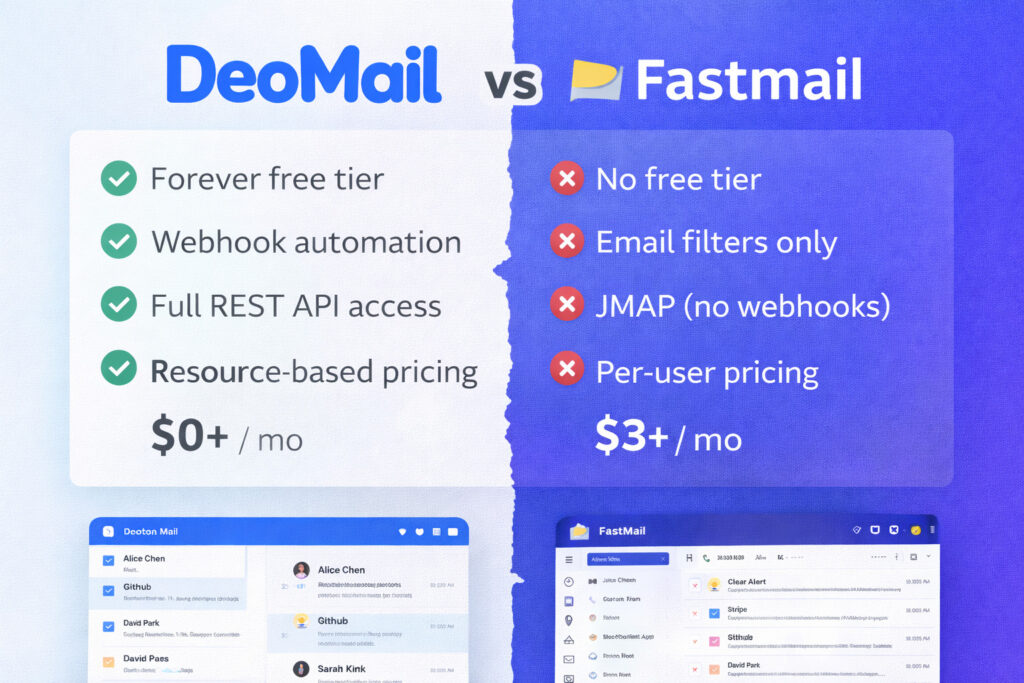
DeoMail vs Fastmail — Quick Overview
Both platforms support custom domain email hosting, but they have different priorities.
| Category | DeoMail | Fastmail |
|---|---|---|
| Pricing | Free forever | $3+/user/month |
| Automation | Fire webhook triggers | Filters only |
| Revocable email | Built-in (Fade) | No |
| Conversation sharing | Built-in (Forward+) | No |
| Email integrity verification | Built-in (Fingerprint) | No |
| API support | Full REST API | JMAP |
| Free tier | Available | Not available |
| Integrations | Webhooks, APIs | Limited |
| Standards | REST + webhooks | JMAP, CalDAV |
Full comparison:
👉 https://deomail.com/compare/fastmail
The Biggest Difference: Traditional Email vs Programmable Email ⚡
Fastmail represents classic hosted email.
It focuses on:
- reliability
- open standards
- long-term stability
This approach works well for users who simply need email hosting with standards like JMAP and CalDAV.
DeoMail takes a different approach by introducing programmable email infrastructure.
This means email events can trigger workflows, integrations, and API actions.
Examples include:
- sending webhooks when an email arrives
- triggering CRM updates
- sending Slack notifications
- integrating with backend APIs
This makes DeoMail particularly useful for developers and modern teams building automated workflows.
DeoMail Pricing vs Fastmail Pricing 💰
Pricing is another key difference between the two platforms.
Fastmail Pricing
Fastmail does not offer a free tier and requires a paid subscription.
| Plan | Price |
|---|---|
| Basic | $3 per user / month |
| Standard | $5 per user / month |
| Professional | $6 per user / month |
Because pricing is per user, costs grow as teams expand.
DeoMail Pricing
DeoMail uses resource-based pricing instead of per-user pricing.
This allows teams to scale infrastructure without increasing costs linearly.
| Resource | Price |
|---|---|
| Storage | $0.50 per GB / month |
| Additional domain | $0.50 per domain / month |
| Extra mailbox | $1.00 per inbox / month |
| Fire automation | $2.00 per 100 executions |
| Team members | $1.00 per member / month |
| Extra organization | $1.90 per organization / month |
DeoMail also offers a free tier, which includes:
| Feature | Included |
|---|---|
| Organization | 1 |
| Custom domain email | Yes |
| Inbox | 1 |
| Storage | 500 MB |
| Emails per day | 100 |
| Fire automations | 50/day |
| Fade | Included |
| Forward+ | Included |
| Fingerprint | Included |
| API access | Included |
👉 Pricing details: https://deomail.com/pricing
Built-In Email Automation with DeoMail Fire 🔥
One of DeoMail’s most powerful features is Fire, the built-in automation system.
Learn more:
Fire allows incoming emails to trigger automated workflows.
Example automation scenarios:
| Trigger | Action |
|---|---|
| Email from orders@* | Trigger webhook |
| Support request email | Create helpdesk ticket |
| Customer inquiry | Notify Slack channel |
| Order confirmation | Update CRM |
Traditional email services like Fastmail typically support only filters and folders, while Fire allows programmable automation triggers.
Revocable Email with DeoMail Fade 🌅
Traditional email is permanent. Once a message is sent, neither Fastmail nor any traditional provider gives you control over it.
DeoMail Fade changes that.
Learn more:
Instead of sending email content directly, Fade sends a secure link to the recipient. The actual content remains stored on DeoMail, and you control access at any time.
This allows you to:
- revoke access to a sent email instantly
- set automatic expiration after 1 hour, 24 hours, 7 days, or 30 days
- protect messages with a password
- limit how many times a message can be opened
Fastmail has no equivalent feature. Fade is available to all DeoMail users at no extra cost.
Email Conversation Sharing with Forward+ ↗️
Sharing email threads with clients or teammates using traditional forwarding creates confusing chains of nested replies, duplicated attachments, and broken formatting.
DeoMail Forward+ solves this.
Learn more:
👉 https://deomail.com/forward-plus
Instead of forwarding emails, Forward+ generates a secure link that displays the full conversation in a clean, readable format. Recipients can view the conversation without needing a DeoMail account.
Features include:
- unique secure link per conversation
- optional expiration
- password protection
- one-click link revocation
Fastmail has no equivalent feature. Forward+ is available to all DeoMail users at no extra cost.
Email Integrity Verification with Fingerprint 🔍
Fake invoices, altered contracts, and impersonated senders cost businesses billions every year.
DeoMail Fingerprint provides cryptographic proof that an email has not been modified since it was sent.
Learn more:
👉 https://deomail.com/fingerprint
Every email sent with Fingerprint enabled receives a unique SHA-256 hash and a verifiable QR code embedded in the footer automatically. Fingerprint is enabled by default on every email you send.
Fingerprint also works on printed documents, making it ideal for contracts, invoices, and official communications.
Fastmail has no equivalent feature. Fingerprint is available to all DeoMail users at no extra cost.
Developer APIs for Email Workflows 👨💻
DeoMail also includes a developer-friendly REST API.
Developers can:
- send transactional emails
- read inbox messages
- automate workflows
- integrate email into applications
Example API request:
POST https://api.deomail.com/v1/send
{
  "from": "hello@yourdomain.com",
  "to": ["user@example.com"],
  "subject": "Welcome!",
  "html": "<h1>Hello World</h1>"
}
👉 Full API documentation: https://deomail.com/api
Unlike Fastmail, the API in DeoMail is available on every plan including free.
Integrations with Modern Tools 🔗
DeoMail is built for modern integrations.
It can connect with tools such as:
- Slack
- Zapier
- Make (Integromat)
- CRM systems
- custom APIs
Because DeoMail supports webhooks and APIs, it can integrate with virtually any service.
Fastmail focuses more on open protocols like JMAP and CalDAV, which are useful for email clients but less flexible for workflow automation.
When DeoMail Is the Better Choice ⚡
DeoMail is ideal for teams that want automation, integrations, and flexible pricing.
Choose DeoMail if you:
✔ want custom domain email with a free tier
✔ need webhook automation for email events
✔ want to revoke or expire sent emails
✔ need to share email conversations cleanly with clients
✔ want cryptographic proof that emails haven’t been altered
✔ want developer APIs for email workflows
✔ prefer resource-based pricing instead of per-user pricing
✔ need integrations with Slack, APIs, or automation tools
Many startups adopt DeoMail because it treats email as programmable infrastructure rather than just a mailbox.
When Fastmail May Be the Better Choice
Fastmail may be a good option if you:
✔ prefer a long-established email provider
✔ want native CalDAV and CardDAV support
✔ prefer JMAP over REST APIs
✔ want a simple hosted email solution
Both platforms serve different use cases depending on how email is used.
Getting Started With DeoMail
Setting up DeoMail takes only a few minutes.
Typical steps include:
1️⃣ Add your domain
2️⃣ Configure DNS records (MX, SPF, DKIM)
3️⃣ Create your mailbox
4️⃣ Start sending email
Setup usually takes around two minutes.
👉 Start here: https://deomail.com
Learn More About DeoMail
If you’re exploring DeoMail for the first time, these guides can help:
API documentation
How to register on DeoMail
👉 https://blog.deomail.com/tutorials/how-to-register-in-deomail/
Google Workspace alternative guide
Final Thoughts
Fastmail remains a trusted email provider known for stability and open standards.
However, modern teams often need more than traditional hosted email.
DeoMail provides a modern alternative by focusing on:
- custom domain email hosting
- built-in automation through DeoMail Fire
- revocable email with DeoMail Fade
- clean conversation sharing with DeoMail Forward+
- cryptographic email verification with DeoMail Fingerprint
- developer-friendly APIs
- open integrations
- flexible resource-based pricing
If you’re searching for a Fastmail alternative, DeoMail offers a powerful solution for teams that want automation and programmable email workflows.
👉 Start here: https://deomail.com
👉 Full comparison: https://deomail.com/compare/fastmail